
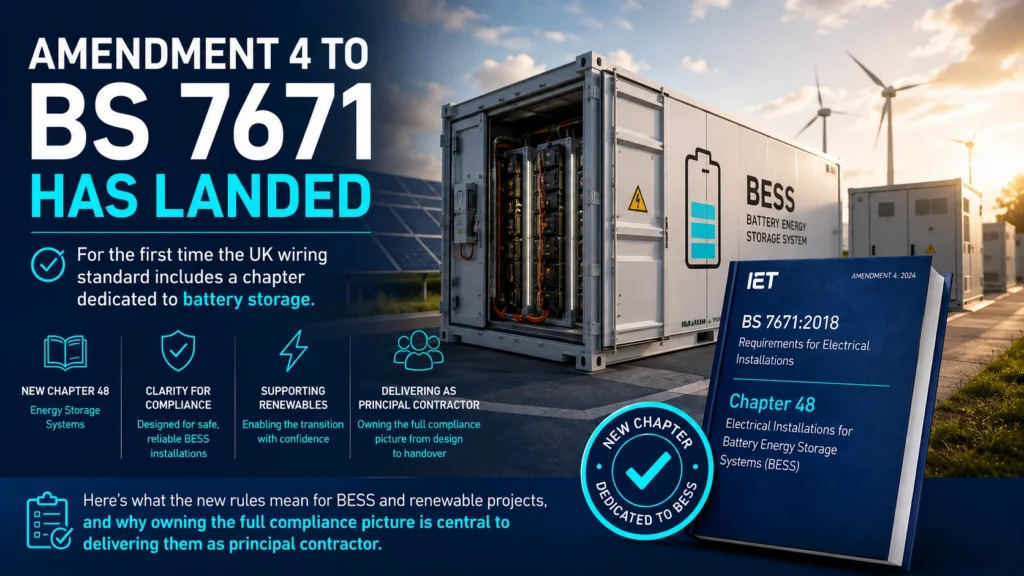
Amendment 4 to BS 7671 has landed and for the first time the UK wiring standard includes a chapter dedicated to battery storage. Here’s what the new rules mean for BESS and renewable projects, and why owning the full compliance picture is central to delivering them as principal contractor.
For the energy storage and renewables sector, the most significant update to the UK’s wiring standard in years has just landed and it speaks directly to the work we do. On 15 April 2026, the IET and BSI published Amendment 4 to BS 7671:2018, the “Orange Book,” and for the first time the standard includes a dedicated chapter on stationary secondary (storage) batteries. From 15 October 2026, all new installations must be designed and built to it.
When the UK’s national electrical standard creates a chapter specifically for battery storage, it tells you how far and how fast the sector has matured. We’ve spent the last few years helping build that market and keeping ahead of standards like this is part of how we deliver as a principal contractor.
Our team recently attended SELECT’s annual Amendment 4 toolbox talk, hosted by Neil Sim and the SELECT team, and we’re rolling the new standard out internally across both Ener-G Services and Aberdeen Electrical Services. Regulatory currency isn’t an afterthought on our projects – it’s part of the responsibility we take on when we act as principal contractor rather than subcontractor. If we’re delivering your project end to end, the compliance picture is ours to own, not yours to chase.
A4 responds to a grid that now runs on power electronics, distributed generation and storage. The changes most relevant to BESS and renewable projects include:
Here’s the nuance that matters on a real project: BS 7671 governs low-voltage installations. The grid and high-voltage connection (the 275kV transmission interface on a project like Blackhillock, for instance) sits under a different framework altogether, including the relevant Engineering Recommendations and grid connection standards. A grid-scale storage or renewable scheme touches both worlds at once.
That’s the core of the principal-contractor argument. Someone has to hold the whole compliance picture together – the LV installation under BS 7671 A4, the HV connection under its own standards, the testing and commissioning regime, the documentation – and make it cohere into one safe, certified, on-time delivery. Splitting that across uncoordinated subcontractors is where risk and delay creep in.
We’ve delivered over 15 grid-scale BESS projects across the UK, with combined capacity exceeding 500MWh – 100% of them on time and on budget. That includes Scotland’s first grid-scale battery system (50MW in Dundee), a second 50MW scheme at Fordtown, and the UK’s then-largest battery storage system at Blackhillock – a 300MW facility connected directly to the 275kV transmission grid, making us Scotland’s only contractor with proven 275kV battery storage experience.
Across every one of those projects, the same principle applied: own the standards, own the delivery, reduce the client’s risk.
Amendment 4 is one more reason to work with a contractor who lives in the detail. If you’re a developer, asset owner or operator planning a BESS or renewable scheme and you want a principal contractor who’ll take full responsibility for delivering it safely, compliantly and on schedule – let’s talk.
Contact our team on 01224 737294 or email sales@energservices.com to discuss your next project.
Ener-G Services Limited
Unit 6E
Kingshill Commercial Park East
Venture Drive
Westhill
AB32 6FQ
© Ener-G Services Ltd • SC682274
Digital Partner: MediaGorilla®